By Shazamme System User
•
August 11, 2026
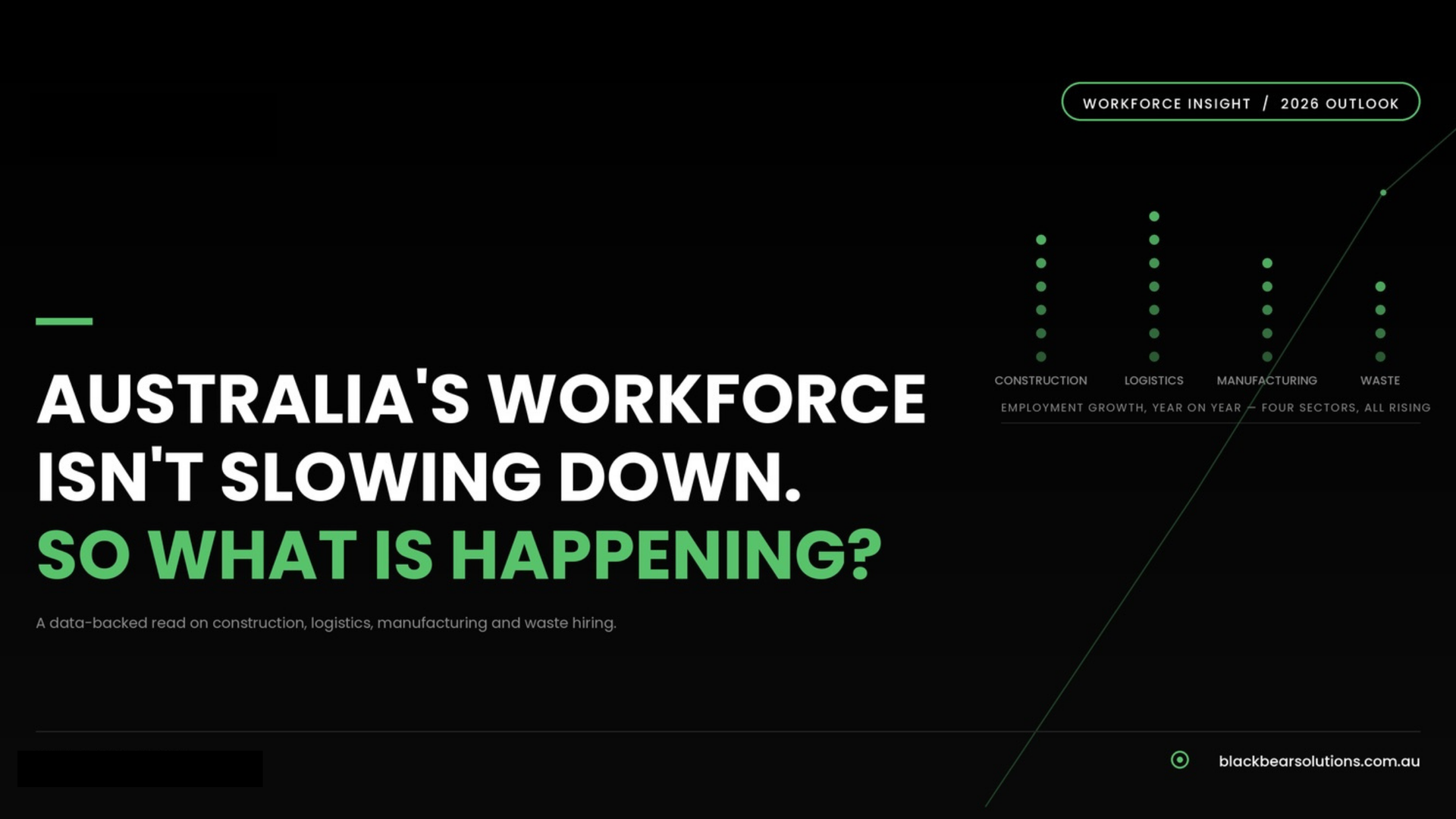
Open the business pages most weeks and you'll find another round of layoff headlines, hiring freezes, corporate restructuring. It's easy to read that as a broad economic cooldown. Look at the industries that actually keep the country running, construction, logistics, manufacturing, waste and resource recovery, and the data tells a different story. Employment in every one of these sectors grew over the past year. Vacancies in several of them are rising faster than almost anywhere else in the economy. The headlines aren't wrong about layoffs happening somewhere. They're wrong about where. Construction: demand has outrun the pipeline Construction employed 1,360,000 people as of November 2025, 9.2% of the national workforce, up 11,900 workers on the year prior (Jobs and Skills Australia). That growth still isn't enough. Every construction trade occupation tracked by Jobs and Skills Australia is currently classified as being in national shortage, the only industry where that's true across the board. The scale of the gap is widening, not closing. Infrastructure Australia's 2025 Infrastructure Market Capacity Report projects a shortfall of more than 300,000 construction workers by mid-2027, up sharply from an estimated 141,000 shortfall recorded just in October 2025. Peak workforce demand on public infrastructure projects alone is projected to reach 521,000 workers by mid-2027. Underpinning it all is a public infrastructure pipeline worth roughly $242 billion across FY2025–FY2029, 14% higher than the year before. This isn't a hiring dip. It's a demand shock that training and migration pipelines haven't caught up to yet. Logistics and transport: growth meets a thin pipeline Transport, Postal and Warehousing employed 745,400 people as of August 2025, 5.1% of the workforce, growing 1.3% over the prior year (Jobs and Skills Australia). Road freight alone employs 183,600 people, and Australia's road freight task is projected to grow 77% between 2020 and 2050 (IRU). The complication is succession planning, not shrinking demand. NatRoad, Australia's national road freight association, puts the 2024 shortfall at roughly 28,000 unfilled truck driving positions, projected to grow past 78,000 by 2029 once retirements are factored in. It's a workforce-planning issue: freight volumes keep climbing while the pipeline of new entrants hasn't kept pace, and the businesses that plan succession early are the ones that avoid getting caught short. Manufacturing: the roles are changing shape Manufacturing bucked the broader national trend of easing vacancies, recording a 16.9% rise in job vacancies in the three months to May 2026, the largest increase of any industry measured. The hardest roles to fill aren't the traditional production-line jobs; they're robotics engineers, data analysts and CNC machinists; positions that didn't exist in their current form a decade ago. That's consistent with the wider national picture: Jobs and Skills Australia currently lists 293 of 1,022 assessed occupations as being in national shortage, and technicians and trades workers record the lowest vacancy fill rate of any major occupational group, at 55.1%. Manufacturing isn't contracting. It's re-skilling faster than the labour market can supply people for it. Waste and resource recovery: policy is creating jobs Less visible, but growing steadily: Australia's waste and recycling sector supports an estimated 106,500 jobs nationally, 36,000 direct and 70,500 indirect (National Waste and Recycling Industry Council). Waste export bans and a national push toward circular-economy targets, including an 80% resource recovery target by 2030, are actively creating new roles in sorting, processing and materials recovery rather than just maintaining existing ones. So what's actually happening? Four sectors, four different reasons, and none of them is "the economy is slowing down": Construction is absorbing a once-in-a-generation infrastructure investment cycle faster than new tradespeople can be trained or migrated in. Logistics is managing steady freight growth against a retirement wave that needs succession planning, not panic. Manufacturing is transforming what its roles even look like, trading process-line headcount for technical and digital skill sets. Waste and resource recovery is being built up deliberately through policy and circular-economy investment. The common thread isn't decline. It's that labour demand in the sectors that physically build, move, make and recover things is outrunning the systems designed to supply people into them. That's a much more useful thing to plan around than a vague sense that "the market is uncertain." What this means for employers Don't read corporate headlines as sector-wide signals. Restructuring in head offices and administrative functions doesn't mean operational roles are cooling. In the sectors above, the opposite is closer to true. Plan workforce needs 12–24 months out, not one quarter at a time. Shortfalls in construction and logistics are structural and were forecast well in advance. Waiting for a quiet moment to hire rarely produces one. Treat retention as seriously as acquisition. With thinner pipelines of new entrants across trades and technical roles, losing an experienced worker costs more than it used to. Onboarding, career pathways and day-to-day conditions carry real weight. Match your hiring brief to how the role has actually changed. In manufacturing especially, the job title often no longer describes the skill set required. A workforce plan built around 2020 job descriptions will keep missing 2026 candidates. Where BlackBear fits in We recruit and place talent across construction, manufacturing, logistics and waste management every day, in NSW, Victoria and Queensland, and what we see on the ground lines up with the data above: strong, sustained demand across every one of these sectors, for different reasons that all reward planning ahead rather than reacting under pressure. If you're thinking about your workforce needs for the next 12 to 24 months, we'd be glad to talk it through. Sources: Jobs and Skills Australia, Industry Profiles for Transport, Postal and Warehousing (Aug 2025) and Construction (Nov 2025); Infrastructure Australia, 2025 Infrastructure Market Capacity Report; NatRoad, "A ticking time bomb" (Aug 2025); IRU, Australia's truck driver shortage deepens as workforce pressures mount (2026); National Waste and Recycling Industry Council (NWRIC).